Knowledge Flow
Just over a year ago, on August 25, 2025, I shared Claritorium, the early seeds of the system I use to create clarity. I talked about how the idea was still in its infancy, but that I would develop the idea through writing about my own experiences.
So I did.
I wrote fifty three more issues. I explored a range of topics, expanding away from tactics and into tools for thinking. Because why hand you the recipe when you can learn how to make your own recipes? That’s leverage. And it’s never been more important as AI grows and chips away at knowledge work. AI can handle more of the output, but there’s still a special ingredient to human creativity. There’s so much about consciousness and the human brain we just don’t understand. Spending time with your unique thoughts is important. If you’re not thinking, you’re not living.
From Claritorium to Equilio
The language of the Claritorium, applied to product work, created Equilio, which I wrote about three months after Claritorium. It was the same core philosophy, applied specifically to building software. The models of Claritorium—Clarity Codex, Clarity Current, Clarity Climate—found their counterparts in Equilio’s product language of Value Creation, Quality Refinement, and Strategic Momentum. These pillars of Equilio were fortified by even more foundational forces of Intuition, Integration, and Iteration. Developing language is how we understand information. It shapes thinking and perception so it’s easier to understand and build knowledge about how things work.
Over the past few years, my thinking and work has grown more intuitive, more emergent, and more intentional. I threw away todo-lists in favor of working through felt signals and embodied responses. I cultivate the conditions so the right work reveals itself. I know it sounds all woo-woo, but it works. I’ve never felt more connected to my work, to the craft.
Rethinking Notion
I’ve used Notion as a personal knowledge system for almost a decade now. I try to be tool-agnostic, but I’ll stick with the tool so long as it aligns with my way of working. And I always enjoyed Notion for the same reason most people struggle with it: its flexibility. You can shape Notion around whatever mental model you use for your work. The possibilities are almost endless. This can be overwhelming for some people, but it was freeing for me.
Through Claritorium, Equilio, and moving into a new company and role, I reevaluated my entire Notion setup. I’m no longer keeping to-do lists or setting lofty goals or breaking work down into strict projects. So why would I keep the same system designed for that way of working? I didn’t. And, luckily, the flexibility of Notion made it easy to reimagine my operating system in a new way. I rebuilt it from scratch using Claritorium as the anchor.
As a part of this process, I also tried a thought experiment: Could I create a core system that would work in any tool? I don’t know if I’ll always use Notion. I want something that works in Obsidian or regular Markdown files or even in an analog system. A good process doesn’t rely on a specific tool.
Emergent Systems
Through the process, three key systems emerged within the larger Claritorium system.
- KnowFlow for developing understanding.
- Solarium for expanding perspective.
- Praxis for embodying understanding.
Knowledge Flow is what I called this issue, which is the long form of KnowFlow, my system for developing understanding. We’ll talk about the other two systems in the next two issues. Consider this part one of a three-part series on my core systems that sit within and next to Claritorium and Equilio.
I didn’t set out to create these systems. They emerged naturally from the work, allowing me to experience the euphoric aha moments when everything clicked into a place.
It’s not done. And it never will be.
But that’s also part of the entire philosophy.
KnowFlow
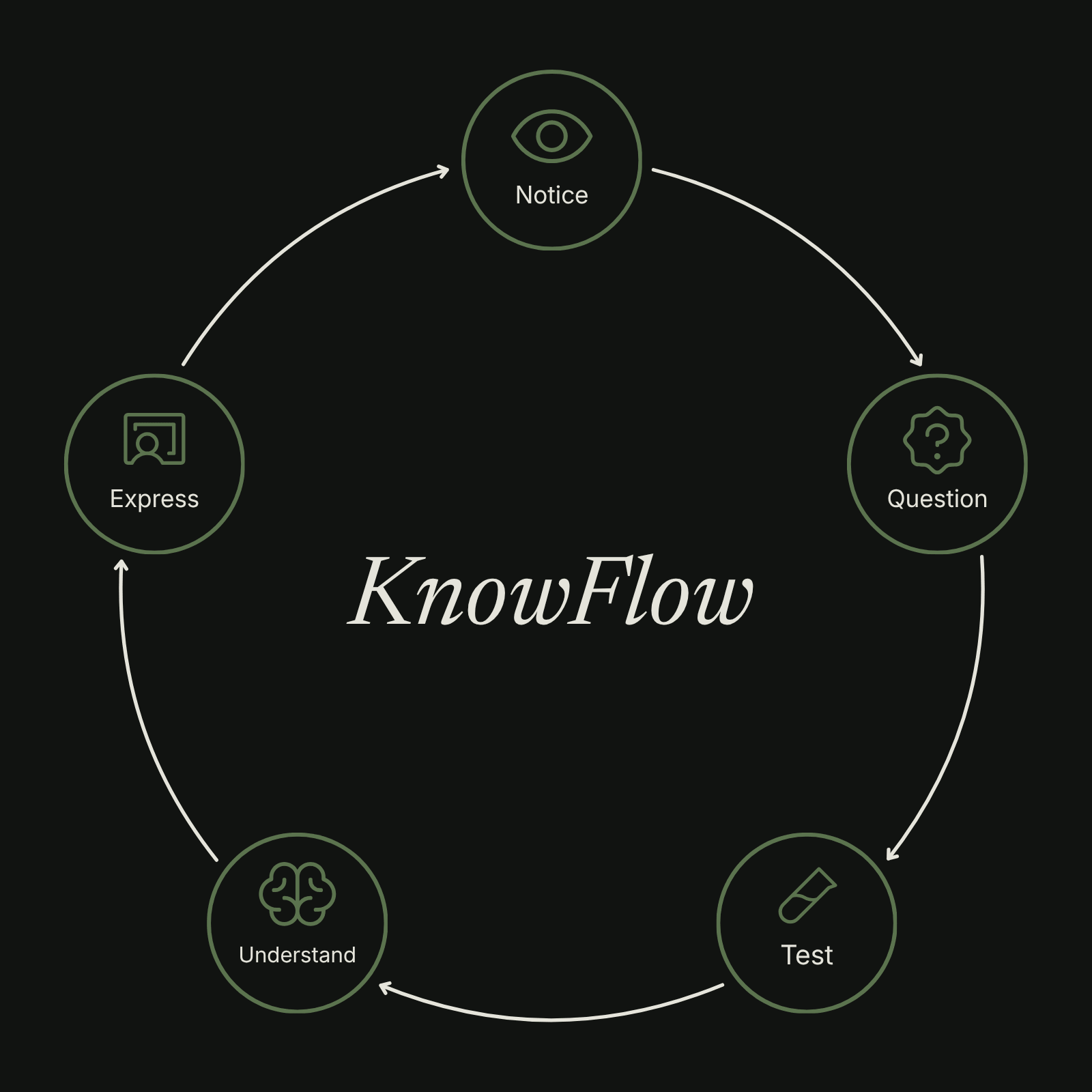
KnowFlow is a five-step flywheel of learning:
- Notice to capture what stands out.
- Question to turn signals into inquiries.
- Test to put ideas against reality.
- Understand to distill what matters.
- Express to make understanding visible.
To stick with my love of triads (everything in threes!), let’s draw lines around these five steps so they fit in three Models.
A quick note about Models
I also refined my language for the areas of knowledge, which is made up of:
- Systems (e.g. Claritorium)
- Models (what we’re about to discuss)
- Patterns (what I shared in Pattern Library)
Models are what I used to call “pillars”. They fill the explanatory gap pillars were meant to, but were also too generic. Models are higher-order organizations of a collection of Patterns.
KnowFlow Models
- Inquiry Formation: Move from Notice to Question to turn attention into questions.
- Reality Testing: Move from Question to Test to put ideas against reality.
- Knowledge Integration: Move from Understand to Express to give learning form.
A Real Example
Let’s use a real example as we walk through the Models and the process. Most recently, Issue #104: Model Mismatch went through all of these steps to land in your inbox and take its place in my system of knowledge. Done repeatedly, you create a flywheel of learning that results in continuous improvements to your life and work. Knowledge is growth.
Inquiry Formation
The first model maps to Open Inquiry. It’s the same process that allowed me to notice the signal in the first place. I was on a thread where a customer reported a bug that was deemed “by design.” I, too, have been guilty of the same reactionary behavior to a reported issue that’s not really an issue. Seeing it second-hand, though, I reconsidered. I was curious enough to move from noticing the signal to questioning it.
That’s what Inquiry Formation is.
You not only notice the signal, but you’re curious enough to sit in the ambiguity long enough to explore it. And I’m telling you: in a world where AI drives for consensus too quickly, letting a problem or idea or tension marinate a bit is a superpower. Don’t rush to a decision. Immediate and decisive action is important, but not everything is ready for it.
I have a Signals database in Notion where I wrote down the first thought:
Design only works if it’s understood.
I wrote about what “design” means, how it’s defined, and the relationship between how something is designed and how it’s perceived.
Then I let it sit.
Later, another signal emerged:
Feedback tells you something useful.
It was closely related, but distinct. Where the first signal was specifically about design, this was about what qualifies as useful feedback.
I added it to the Signals database.
I had enough to formulate the question. At that point it becomes an Inquiry.
But not everything moves from a Signal to an official Inquiry. Sometimes nothing happens.
Just recently I read The Infinity Machine by Sebastian Mallaby and wrote down a new signal about AI and the pursuit of understanding intelligence. I wrote my theory for why AI comes up short replicating human intelligence with how it’s being trained.
It also sat there. But then I just archived it and didn’t move it further. That’s fine. I suspect it will connect to another signal later.
Moving to an Inquiry requires proper framing of what you’re seeking to understand. You leave it open, but with enough constraints to focus your attention. I inquired:
What can feedback reveal about the gap between someone’s mental model and reality, and how should that gap be addressed?
The Inquiry has:
- The current inquiry you’re seeking.
- The working theory (or theories).
- The next move to move forward.
Reality Testing
Everything before you meet reality is a simulation. Nothing matters until you engage with the real thing and see how it responds.
The example Inquiry here didn’t require a test for me to move it to the next stage. But if it did, I could have formulated a theory and tested the outcome. For example, I could have tested the example where the design and someone’s mental model were different. I could have asked the customer what they were expecting and why, and done so for multiple customers to confirm the hypothesis.
To run a test, you need:
- The assertion you believe to be true.
- The experiment you will run to test it.
- The learnings you gain from the test.
Keep the test small. Choose a start and end date to keep it constrained. And don’t test more than you need to. Do the smallest test that helps you prove your theory, disprove it, or point at what to do next. Most of all, make sure you stay open and curious. There is no result where you fail because any learning is a learning. We learn more from something not working or failing than we do when it works.
Knowledge Formation
The final stages of KnowFlow are where you solidify your observation and learning into hardened knowledge you can use.
It comes in two parts:
- Knowledge by distilling the Systems, Models, and Patterns that emerged.
- Express by translating the knowledge into shared learnings, stories, and language.
Knowledge contains Systems, Models, and Patterns. Systems contain Models, Models contain Patterns. And Models can contain more submodels within. For example, my Clarity Engine Model resides within the Clarity Codex Model in the Claritorium System. It should map to your unique mental model for information pertinent to you.
For this example, it became the Model Mismatch Pattern—the pattern, philosophy, principle, practice, and formula distilling the knowledge into a coherent concept.
Express is where you share the knowledge in a way that solidifies your understanding of it. I do this through writing. I’m sharing the knowledge of how I build knowledge with these words right now! And it doesn’t have to only be writing. You can teach someone or share videos or design visuals. Aristotle said it best with “Teaching is the highest form of understanding.” I don’t feel like I understand something until I can explain it simply. Not in the way Claude or ChatGPT vomit hundreds of words that often say very little. But by creating a simple narrative to convert information into a transferable unit of data.
I shared this example in Issue #104. I like to ground the learning in a real story that shows how it meets reality. Theory is a beginning, but learning truly comes from reality and empirical evidence gained from real experiences. The more you begin to notice, the more you start to truly see.
Claritorium Documentation
As part of the process redesigning my entire system, I extracted the foundational parts you can use in any system. I took those and put them in documentation on GitHub. It’s not much right now, but I intend to expand on it and share more documentation as I explore the Claritorium even further.
Find your system. Root it in language you see and understand. That’s how you form the patterns and relationships that weave into a coherent whole. A system can be complex, but simplicity is where artistry lives.
KnowFlow is a simple system I use to notice signals, engage curiosity and question them, try them out, layer them into my existing thinking environment, and expand my understanding through expression.
I hope it helps you do the same. And, if not, at least get you thinking about the process you engage to learn, grow, and expand.
Enjoying this issue? Sign up to get weekly insights in your inbox: