Emergent Environments
When I work on new products, I typically work with two engineers. The team is small, but it’s efficient and effective. When priorities change, it only takes a quick huddle to align everyone.
Bigger teams? Not so much.
The team I’m leading now includes two EIRs and five engineers. And there are more stakeholders directly involved than usual.
When two people work together, there is one line of communication: Person A to Person B.
As you increase team size, the lines of communication grow considerably.
A team of three has three lines of communication.
A team of six has fifteen lines of communication.
You get the point.
Controlling communication and creating the right behaviors on a team is difficult. Quick one-off reminders won’t cut it. You have to invest in more strategic ways to let the right team behaviors surface. And this becomes even more challenging as the team size increases.
So then the question becomes…
How do you create a team environment where healthy behaviors naturally emerge?
My approach is Memes, Models, and Moments.
Memes
Richard Dawkins, British evolutionary biologist, coined the term “meme” in his book The Selfish Gene in 1976. He used the term to describe a unit of cultural transformation or a piece of information that replicates and spreads among people, similar to how genes propagate biologically. He likened them to “mental genes” that evolve through imitation and sharing.
When you hear the word, your first thought might be of viral memes spread on the internet. These are “internet memes”, and they are a modern example of the original concept Richard Dawkins coined in 1976. The internet simply accelerates the transmission of ideas.
So how does this help create team environments where healthy behaviors naturally emerge?
I’ll give you an example.
I was struggling to get the engineers to add issues to Linear, our issue-tracking system where we organize all development work. There were long Slack conversations where issues were surfaced, yet no one put the issue in Linear until I either told them to do it, or I did it myself.
So I fired up ChatGPT and used the latest image-generation model to create the “add to linear” meme.
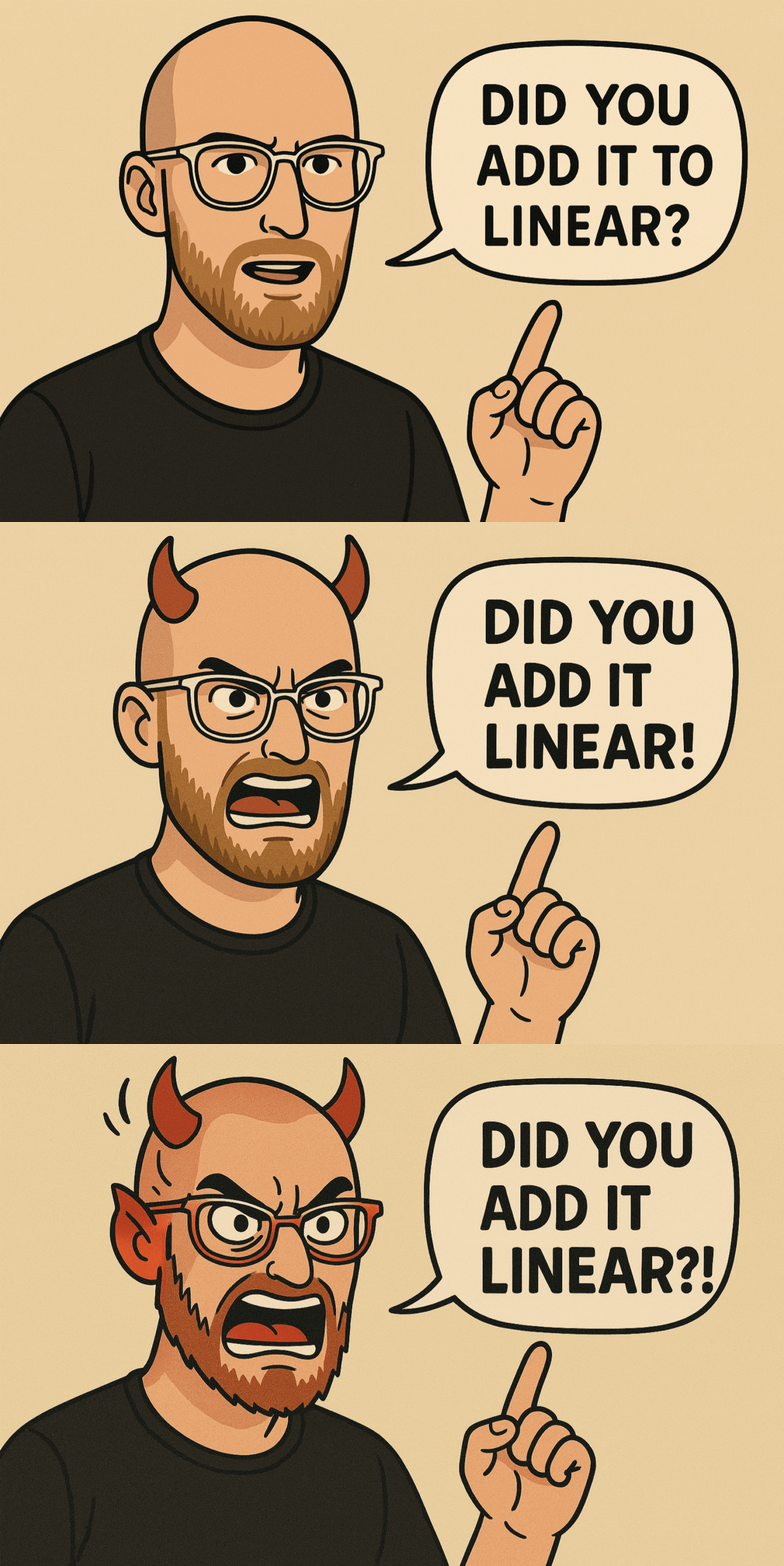
Is this ridiculous? Yes. But it’s also effective.
Anytime we say “add to linear” in Slack, this meme shows up. It’s a simple and visual reminder that replicates the idea of tracking work in Linear across the team. I ran this as an experiment, and there was a decisive uptick in Linear issues created by the team. Win!
Now I’m working on new memes to spread additional behaviors like updating the status of issues and creating Slack messages as threads to organize conversations. I created a “Meme Generator” custom GPT to help distill concepts into the simplest idea as memes.
It reminds me of a scene in Christopher Nolan’s Inception, where the characters played by Leonardo DiCaprio and Tom Hardy discuss the idea they want to “incept” in their target. “You need the simplest version of the idea,” said DiCaprio’s character, Cobb. For the idea to take hold and replicate, it needs to be simple.
That’s the key—you have to create the simplest idea possible. Distill it into a simple phrase that is easy to repeat, memorable, and sticky. I like to use rhymes, alliteration, and visuals to increase the virality of the meme. Be intentional and consistent, and watch the right behaviors naturally emerge on your team.
Models
While memes help replicate ideas that drive team behaviors, models help teams understand key concepts. A mental model is a simplified internal map we use to understand how something works.
The problem?
They are individual, invisible, and often unconscious. On a team, everyone has their own mental model of “what good looks like,” “how decisions are made,” or “what urgency means.”
A shared mental model on a team is a consciously co-created version of reality the team agrees to operate from.
I like to build mental models in three ways:
- Visuals like flowcharts or diagrams.
- Language that clearly defines terms and words like a shared glossary.
- Metaphors that emphasize key concepts with understandable representations.
Visuals
Visuals are what is seen. My favorite way to create a shared visual mental model is with a digital whiteboard in FigJam or Whimsical.
I create a “Status Board” that communicates where we are in the project. And then I use this in Weekly Updates (Issue #11) and when I share my screen in team meetings. It may seem like a small thing, but sharing your screen while talking to your team is a subtle way to create Visible Alignment, a concept I discussed in Issue #27. This, obviously, assumes you’re working with your team over video calls, not in person.
Use visuals to help your team see mental models to gain shared understanding.
Language
Language is what is said. I’m a stickler for language. I love naming things. You, dear reader, are witness to my obsession with naming, as evidenced by the names I create to convey concepts in this newsletter.
Emergent Environments is one such example.
The term is written as a proper noun and used consistently to fortify its meaning. This is a subtle but powerful nuance that helps shape mental models on your team.
In software, this comes to life as:
- Pillars: Strategic priorities that drive the work (e.g. Operational Excellence).
- Functions: Areas where work flows in terms of inputs and outputs (e.g. Go-to-Market).
- Domains: Parts of the product where work happens (e.g. Onboarding).
When there was high uncertainty early on in my current project, I started with the Functions. From there, the Pillars developed. And now we have Domains where work is organized. It takes time to find these, but they create powerful mental models for your team.
Metaphors
Metaphors are what is felt. When our team was working with high uncertainty, I used metaphors to help everyone understand the process.
Early discovery work on a large team is like being in an open field. When someone spots something, we all run over to it and decide what it means together. Nobody is doing the Scooby-Doo thing and splitting up. As we create a shared understanding and get our bearings, paths start to open. That’s when we can start venturing off in specific directions.
This was the mental model I used to help the team understand how we operate early on. This drove specific behaviors like sharing information across functions and huddling on calls when new information surfaced.
Was it the perfect metaphor? No, but it served its purpose and helped the team understand where we were and how to operate.
Moments
While Models co-create a shared understanding and reality for the team to operate in, Moments are key events that highlight specific behaviors. If you use Memes and Models effectively, you should experience a lot of these Moments.
- A team member proactively captures issues in Slack and adds them to Linear.
- Updates are added to an issue and unknowns are called out in a meeting.
- Specific language is used to communicate the work without prompting.
These are the artifacts—the snapshots of work—I discussed in Issue #35. Not only do they tell the evolutionary story of the work, they create key learning moments to teach your team.
Last week, an engineer added a detailed update to a Linear issue without any prompting. In our team meeting, I highlighted this as a great example of proactive communication.
Humans love stories. This is how we’ve passed information through time. And it’s still the best way to relay deeper meaning to your team. Don’t lose these moments. They create unique opportunities to connect real outcomes to key behaviors, further strengthening team culture.
Be a Gardener
You can’t force your team to operate a certain way. Well, you can try. But you’ll be met with resistance and unsuccessful outcomes.
Focus on creating an environment where healthy behaviors naturally emerge. Think of it like gardening. You’re not shouting at the plants. You’re making sure there’s healthy soil, adequate sunlight, and enough water. You are creating an environment, not controlling it.
When you lean into spreading simple ideas through memes, creating shared mental models, and highlighting moments of clarity, your team will thrive. Healthy behaviors emerge as natural byproducts of the environment.
This is what an Emergent Environment looks like.
Enjoying this issue? Sign up to get weekly insights in your inbox: