The Claritorium
Over the past 50 issues and nearly 12 months of writing this newsletter, I’ve used this space to explore topics, share insights, and build language around the work—the craft.
For most of the issues, I named a situation, a story, or a real-life example. Doing so allowed me to surface insights from real situations, and retroactively define the situation so I could learn from the experience. I hope you’ve experienced similar learnings with what I’ve shared.
If you spend enough time on social media, you will be bombarded with information designed to make you think every solution is just one more framework away.
It’s not. We like to shrink complexity into neat little packages and pretend they’re simple. You just need to follow these three steps; or read this one book; or watch this one TED Talk over and over until you understand it. But that’s not how it works.
Such knowledge is ephemeral—it’s forgotten almost as quickly as it’s collected. The real, powerful, and sustainable knowledge lies in a deep understanding of the underlying forces at play: the principles, the philosophies, the systems.
Principles First (Issue #18) was when I first codified this thinking. I realized my superpower wasn’t in the tactics I deployed, but in the understanding of the underlying principles that form a process, build a framework, or surface an idea.
Why? Because that knowledge is transferrable. Understanding a principle of one domain creates a raw material you can use to reason with and apply to one or many other domains.
This is why I believe strongly in generalists (Issue #1).
About 10 years ago, the front-end development world—in the JavaScript ecosystem, specifically—was swooning over a suite of frameworks: React, Angular, Backbone, Vue, and their ilk. While each one had strong proponents behind them, they were serving the same fundamental goal of improving the developer and user experience by solving common front-end challenges. Namely, managing state. When a user does something like click a button to upvote a post, they expect to see their vote counted immediately. This is a non-trivial thing because it requires the front-end communicating with the back-end over a server, saving the data in some way, and reflecting that saved state back to the user in the form of an interface update. Before these front-end frameworks showed up, developers mostly did this with full page refreshes (not ideal), or older JavaScript techniques that were cumbersome and difficult to maintain. But with these new frameworks and techniques, the updates on the front-end (the state) could be more easily managed without all the previous headaches. Huzzah!
But then the question became: What framework should I learn?
I can’t begin to tell you how many times junior developers asked this question. Or how many times this came up in the interview process. I remember applying for a job where Vue was their framework-of-choice, and when asked about knowing Vue or not, I said, “No, but I understand the underlying technology Vue enables.”
Programming languages are all syntax. Variables, functions, and loops are the transferrable materials. Once you understand those, you can pick up other programming languages without getting stuck in the weeds of the nuance. You can even go deeper than those primitives and understand that a variable is just a container of information that can be reused when needed; or a function is a mechanism that accepts inputs, does something with those inputs, and returns an output; or a loop is something to repeat an action until a specific condition is met.
You can always go deeper. In doing so, you interact with the forces at play.
This is the reason Leonardo da Vinci spent so much time studying the flow of water and other elements of nature. His obsession allowed him to understand the hidden structures and invisible forces that shaped nature. He transferred this knowledge to the art of painting, which can only be done when you reason by analogy. And analogizing is only possible when you experience a diverse collection of information. That’s where the patterns live.
I believe strongly in this way of thinking, and it’s allowed me to learn more quickly, be more effective, and make considerable leaps in my thinking, career, and output.
While writing this newsletter, I’ve been building the language, uncovering the principles, and unlocking the key insights that represent my entire way of thinking. It’s not just a philosophy, but a living system in which clarity continually emerges and is refined. It applies individually, but also with the teams you work with, the companies you work in, and the societies you inhabit.
I call it The Claritorium, and I want to share it with you today. This is a work-in-progress, but I believe in the value of the thought process, so I’m putting it on display. Some of it is more refined than other parts, but everything I discuss in my newsletter has found its place in this space.
This is meant to be an overview, leaving space to go deeper on individual parts. I want to use the language in future issues, so having this definition written down provides the reference.
And yes, sometimes I just share a tactic, process, or system in this newsletter. But each of those tactics, processes, and systems were created through this process—of finding the patterns and integrating them into a tangible output.
That is the leverage. That is where the real value lives, and it’s a skill that compounds.
Etymology
You might be asking yourself, “What the heck is a ‘Claritorium’?”.
Great question!
After several hours of conversation with ChatGPT, I asked about key terms from the Enlightenment and Renaissance periods. It mentioned ‘Scriptorium,’ which was a place where monks and scribes would copy texts by hand in order to spread knowledge.
I loved that concept, so I paired it with my key word (the ultimate outcome): clarity.
My superpower is structuring complexity into clarity, so it felt fitting to name this with the combination of “clarus” (Latin for clear, bright) and “-torium” (a place for a specific purpose).
Claritorium means “a place where clarity is cultivated.” Defined further:
The Claritorium is a living clarity system that transforms ambiguity into aligned action through continuous cultivation. It weaves hidden structure, invisible force, and emergent environment into a generative field of motion and insight.
I even created claritorium.com to lock down the name and publicize this early concept. As you’ll see, I’m pointing back to this very newsletter you’re reading as the space to share these concepts, test them, and continue to refine them publicly. It makes me feel like part of the Enlightenment when ideas, knowledge, and curiosity spread through freethinking and inquiry. But I’m no Voltaire.
Three Subsystems
There are three subsystems that make up The Claritorium. I intentionally call them subsystems instead of pillars (like I typically would) because they are independent entities that, when working in unison, form the living force to make clarity inevitable.
Clarity Codex
The Clarity Codex is the foundation of the system. Principles First (Issue #18) was the first seed of this idea, which expanded into the Clarity Engine, the first pillar of the Codex.
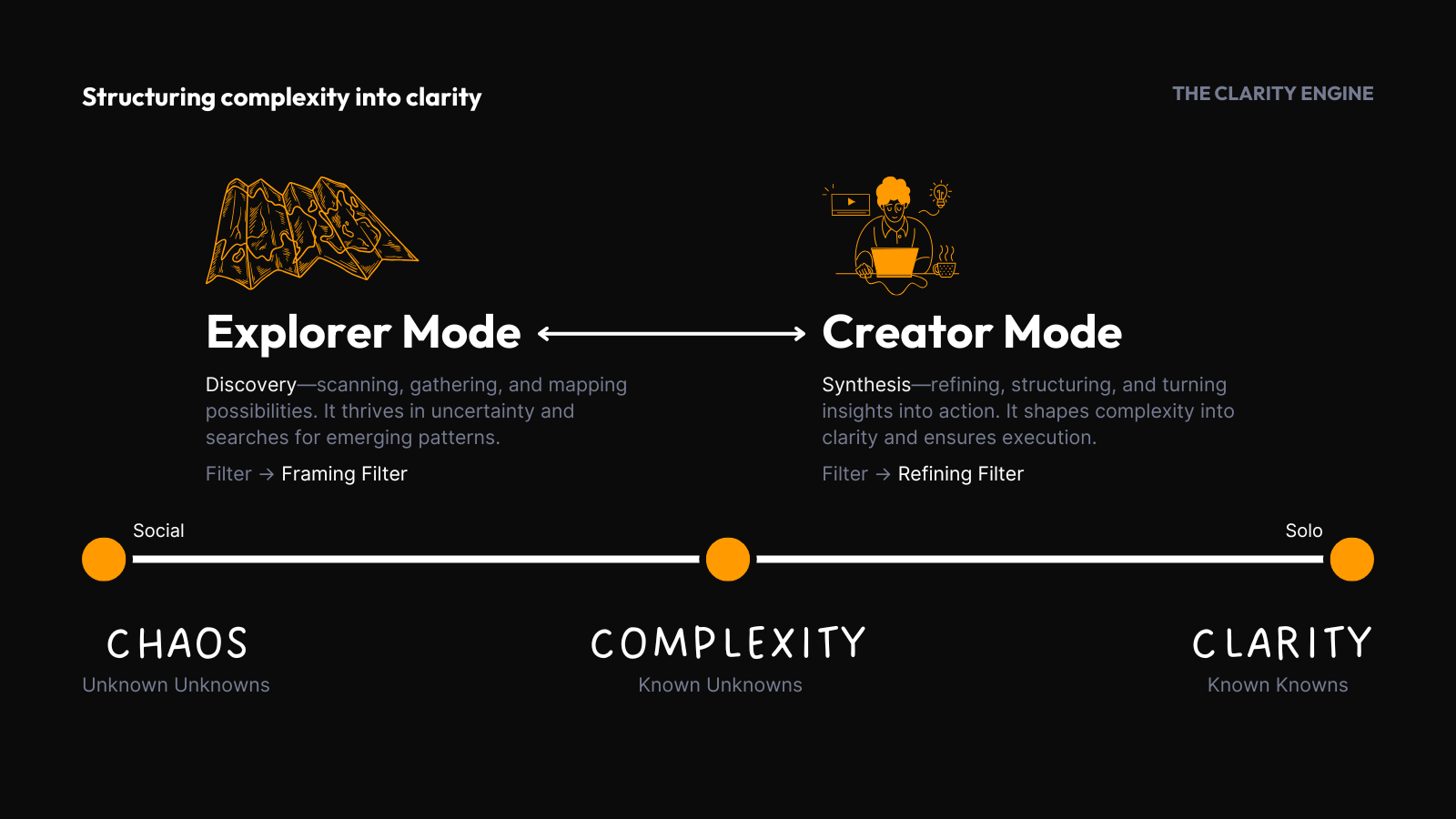
I mentioned that my superpower is structuring complexity into clarity. In order to do this, I operate in the force that precedes complexity: ambiguity; or, as I like to call it, chaos.
This is how I perform the alchemy. It may not be how you will. What’s important, though, is that the Clarity Engine creates a frame for you to generate individual clarity. I intend to share more about my Clarity Engine in future issues, as this is the most refined part of my Claritorium.
Once you gain clarity, you typically need to share it collectively. So how can you get others to experience the same clarity? Through what I call Information Ecology. Information Ecology is how information originates, mutates, and spreads through a collection of people: teams, companies, or any group of individuals.
As you expand beyond teams and into larger collections of people, you enter into structures that persist in society. I call these Human Systems, the third pillar of the Codex. To better understand this layer, I read a lot of books about history, politics, and social sciences. Again, this is a topic I want to explore more deeply in future issues.
Creating clarity at scale—from yourself to your team to society—requires a deep understanding of the hidden structures that connect complex systems. The Codex helps you understand clarity at multiple levels so you can operate effectively in any environment.
The goal of the Clarity Codex is to see things others don’t. That’s a superpower.
To summarize, the three pillars of the Clarity Codex are:
- Clarity Engine: Your personal engine of clarity to move from chaos to clarity.
- Information Ecology: How information originates, mutates, and spreads collectively.
- Human Systems: How institutional structures function as a larger unit of clarity at scale.
Here’s a design I created to represent the Clarity Engine and how I operate within it:
Clarity Current
While I was on vacation, someone on my team referred to the time they spent operating in (part of) my role as “Drewing Around.” While I laughed at the phrasing, I love the underlying essence of the specific language. It’s about motion, movement, and momentum.
Clarity, like all forces, requires energy to generate its effects. The motion—or current—is that energy of movement that weaves an invisible force around a group of people. Remember how I said the goal of the Clarity Codex is to see things others don’t? This invisible force of the Clarity Current is one of the first things you’ll notice. And, like the Codex, your Current will look different than mine. But the specific expression will shed light on the possibilities.
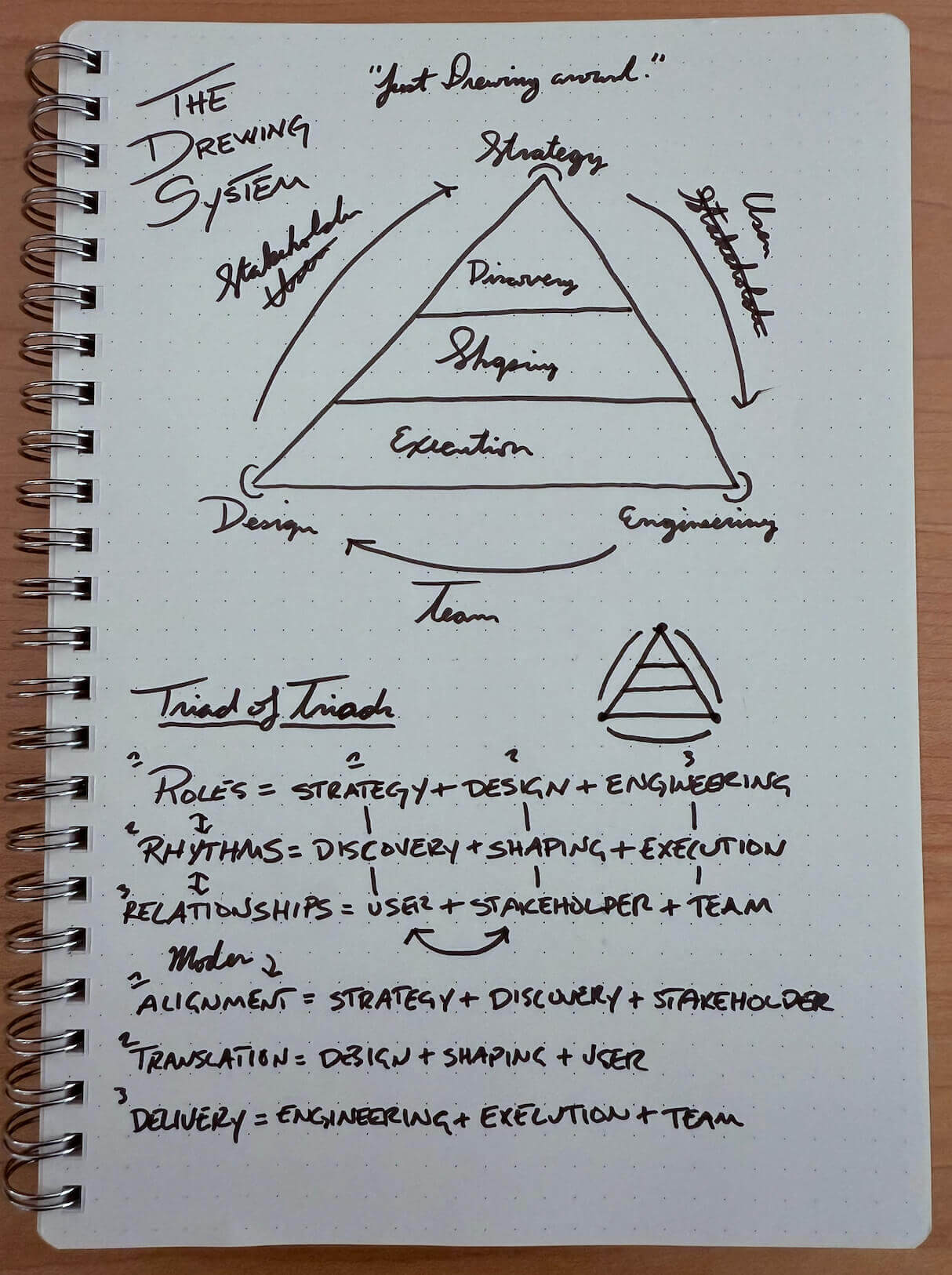
The core triad of product work is design, engineering, and strategy. I started in design, learned software engineering, and then leveraged my Type A skills into strategic thinking through leading teams, working with customers, and talking to users. These are the Roles, the first pillar of the Clarity Current. Sometimes I’m thinking about design; sometimes I’m digging into the technical details and writing code; sometimes I’m thinking about different ways to accomplish our goals. This is the Current running through the Roles.
When you’re building a software product, you spend time in distinct phases:
- Discovery when you’re trying to figure out what to build.
- Shaping when you’re trying to figure out how you can build it.
- Execution when you’re building, iterating, and bringing it to life.
These are the Rhythms of the work, and the second pillar of the Current.
Working on a product also requires working with people. No matter what work you do—agency or SaaS—there are stakeholders: executives, customers, users. They are people. They have their own motivations, desires, and emotions. And people are complex. The Current running through people is Relationships, the third pillar of the Current. Learning about behavioral psychology, social sciences, and through lived experience has helped me better understand people.
The goal of the Clarity Current is to build things others can’t. And the only way you can do that is when you see, understand, and know how to manipulate the invisible force driving the work. I may sound like Yoda or Obi-Wan Kenobi espousing the power of The Force and how to harness it, but I also feel as strongly as The Jedi about this power. It’s not something people can point to, copy, or easily replicate. It’s felt. And it requires constant motion to generate energy to sustain it through the elaborate network of interdependencies.
To summarize, the three pillars of the Clarity Current are:
- Roles: Strategy + Design + Engineering
- Rhythms: Discovery + Shaping + Execution
- Relationships: Stakeholder + User + Team
Another important part of the Clarity Current is the interplay of these pillars. When they are combined in specific ways, it creates three unique modes I operate in:
- Alignment: Strategy + Discovery + Stakeholder
- Translation: Design + Shaping + User
- Delivery: Stakeholder + User + Team
I like to define “modes” because it creates a verbalize-able term to switch my mindset. I know I’ll operate differently when I’m working with stakeholders on alignment than translating user desires into defined work than working with engineers to modify scope and ship the work.
Here’s a sketch in my notebook where I defined “The Drewing System” that eventually became the Clarity Current. The visualization helped me understand how the current flows.
Clarity Climate
Once the Clarity Current is generating the invisible force around your team, you need to make sure the team is focused and operating with intention. The invisible force is an energy, but you never want to apply internal force or pressure to drive behaviors. You want key behaviors that drive clarity to emerge naturally and organically. The Clarity Climate is an emergent environment where clarity is created, shared, and perpetually reinforced.
Said another way: The Clarity Climate is the team’s culture. When I lead teams, I focus on establishing the values, principles, and philosophies of the team (Issue #4). These aren’t things you write down—they’re lived. A value is upheld when you make a specific decision; a principle becomes a filter to make an intentional choice; a philosophy provides a framework for thinking through a specific problem. These moments become stories and build a culture. Because what is a culture but a representation of the stories we tell to teach the values we stand for.
We’ve spent centuries passing information through stories because of their logical progression, emotional resonance, and practical applicability. They’re powerful. And they form the foundation of building an emergent environment on your team.
The goal of the Clarity Climate is to say things others won’t. It’s not only the unique language, stories, and values you share, but how, why, and when things are said. It’s about how you work together (Collaboration), how you focus on the work with intention (Precision), and how you adapt with the inevitable and perpetual changes (Adaptation). It’s the atmosphere of clarity.
To summarize, the three pillars of the Clarity Climate are:
- Collaboration: Working out loud to align through trust and open communication.
- Precision: Using clear constraints to create focus and guide intentional work.
- Adaptation: Learning through reflection, feedback, and refinement.
Evolution
Language signifies meaning, creates shared context, and establishes a foundation of knowledge.
It’s for this reason I invest so much time thinking about language.
The human brain has been evolving for millions of years. It’s one of the most complex pieces of technology in the known universe. Inventing language to cooperate in groups toward common goals is just one part of the brain’s history. But now we use the same capacities to understand information, share ideas, and take knowledge to its logical end: clarity.
The Claritorium is the living force of clarity. It’s a system, a space, an ecosystem. It’s where you better understand yourself, share knowledge with your team, and affect change in the world by seeing the hidden structures—the patterns of holism connecting all things. It’s where you generate motion and construct an invisible force that drives focus and intention. It’s where you build an emergent environment that makes clarity an inevitable outcome. It’s powerful. And it will change how you see the world, operate within it, and impact those you work with. You will work at another level others will seek to attain. You will thrive.
I believe strongly in this force. I will continue building out the ideas, share them freely, and interrogate the concepts with real-world practice. Just as Leonardo da Vinci oscillated between theory and experiment, I move between exploration and creation, avoiding the trap of siloed thinking, unnecessary red tape between disciplines, and mindless productivity. AI is advancing rapidly, but we’re on the verge of a Thinking Revolution—a time where radical self-inquiry, freethinking, and the philosophical pursuit of what it means to be human reemerges.
The Claritorium could be the cradle of the revolution—of your revolution.
Enjoying this issue? Sign up to get weekly insights in your inbox: