Thinking Current
Imagine two scenarios.
In Scenario A, someone on your sales team messages you and asks you to demo the product to the customer. You say yes. During the demo, you notice they’re drifting off and not paying attention. They’re answering emails or catching up on other tasks. They asked you to demo for them because you have knowledge they don’t, but then they’re making no effort to acquire that knowledge. They asked you a question, you did the demo, and they moved onto the next task.
In Scenario B, you ask Claude to synthesize a call transcript and generate a summary so you can send a follow-up email to the customer. It pulls the raw data, synthesizes it, and drafts a legible email response. You gain time back in your day, avoid admin work, and increase efficiency. Right? Then the customer asks a specific question about the meeting, pointing out a critical gap in the next steps Claude summarized. So now you’re left missing the understanding necessary to respond.
Scenario A has always existed in knowledge work, even before AI. Scenario B is new, but it’s part of the same underlying problem.
In Scenario A, the sales person is the prompter.
In Scenario B, you are the prompter.
The prompter is whomever initiates the request to generate an output.
A thought is required to generate the prompt, but thinking is a continuous motion. It doesn’t stop when you hit enter or end your sentence.
Thinking is like a current of water. When it’s flowing, it creates life and carves new pathways of meaning and possibility. When bypassed, it’s like standing water, stagnating and decaying.
Both scenarios result in incoherence. You don’t understand the output because you abandoned the process of thinking. This happens whether you use AI or not. Ignoring your cognition is disrespecting the beautiful and powerful gift living in your head.
AI helps you move faster; that’s great. But fast isn’t always best, especially when it’s at the cost of understanding—of forming rich mental models you can use to build a complex understanding of new information.
That is why both scenarios are so insidious.
You’re eroding the ability to form mental models, build leverage with new knowledge, and create a deeper understanding of the work through relationships built through the process of deep, slow, and deliberate thinking.
I’m not anti-AI; I’m pro-cognition. I believe in the power of AI to expand human intelligence, not constraint, limit, or remove it.
The Thinking Current is how I’m cultivating my ability to think in a world where AI erases friction. Friction is a formative pressure. It helps to create clarity because clarity emerges from the process—not the prompt; not the output; not the backseat vibe-coding.
The future belongs to people who preserve their ability to think slowly inside systems designed for speed.
The Thinking Current flows through three distinct stages across five spaces.
The stages:
- Collection for capturing.
- Formation for shaping.
- Integration for sharing.
The spaces:
- Capture Space to preserve the signal.
- Reflection Space to think slowly.
- Mapping Space to see the relationships.
- Exploration Space to expand possibilities.
- Alignment Space to construct shared meaning.
Each of the spaces are like thinking environments flowing through each stage.
Collection
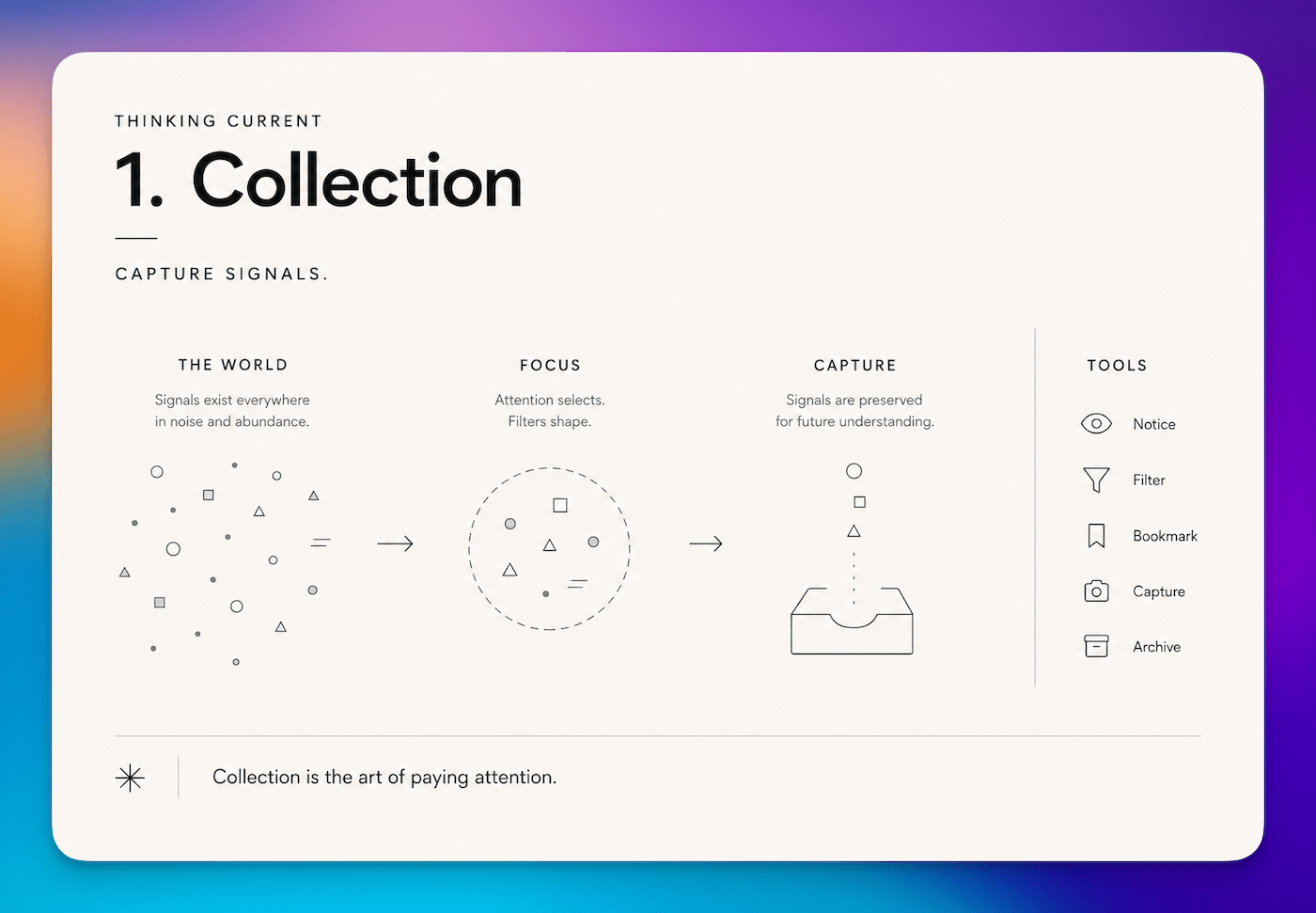
Collection is the Capture Space. Your thinking environment is focused on observation. You’re like a radio tuning to find a signal.
Start with notebooks.
I say notebooks because you can work across both digital and analog. They serve distinct functions in the thinking process.
I like analog when I need to be messy, iterate easily, and move slowly. The friction forces you to think before you write. And the imperfections prevent you from committing to one path of thinking too soon.
Digital notebooks are better for bookkeeping as a ledger of your progress. Where an analog notebook represents stages of thought, the digital notebook represents the current state.
Analog vs. digital is really a representation of formation vs. generation. To understand something, you need to form a mental model of the idea. And to do that, you need to take part in the process of thinking.
Collection is your internal cognition.
I use notecards during the week to write down short ideas. I put one card on my desk and often distill up to three simple ideas. These are the seeds of this very newsletter.
There’s just something about writing these by hand. It sinks into my consciousness more deeply, allowing the idea to evolve and grow as I continue thinking on it. And I like the tangible artifact. Writing them out and then reviewing them at the end of the week is a process I enjoy. I transfer the ideas into Notion, my digital-notebook-of-choice, and then use those snippets to form larger ideas.
I use Notion AI to transcribe the ideas as individual notes in my Insights database, which makes it easier to pull those ideas together when I write my newsletter.
Collection is the observation, curation, and contextualizing of thinking.
Formation
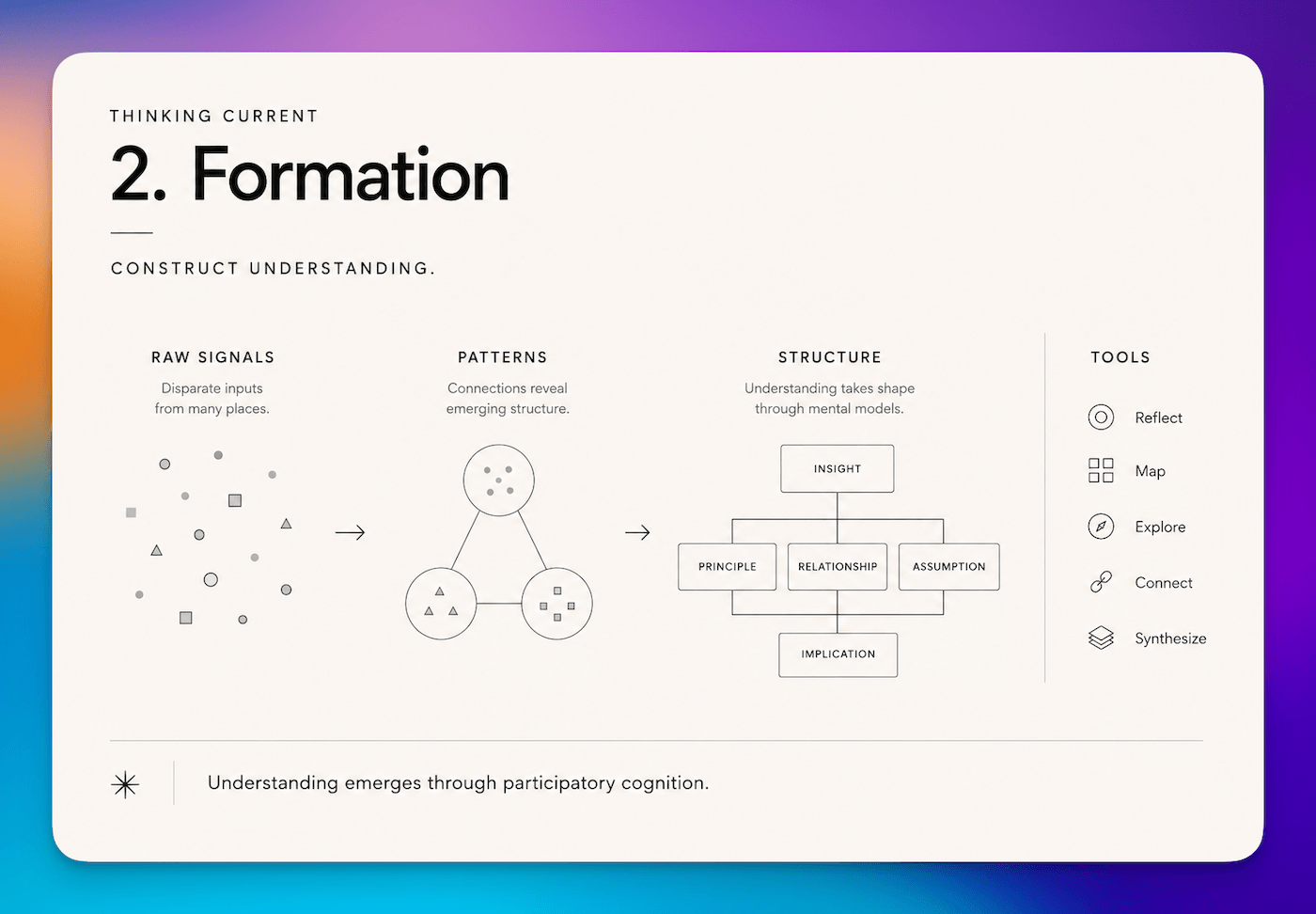
Formation is made up of three spaces:
- Reflection Space for processing.
- Mapping Space for visualizing.
- Exploration Space for ideating.
Your thinking environment shifts into shaping as you reflect, map, and explore.
Try using mind maps.
The information is the same as a hierarchical bulleted list, but represented in a visual map of connections and relationships. I’m a visual learner, so I need something to look at so I can understand the shape and form of the emerging idea. Then I can see causal relationships and patterns weaving together.
A “map” is a better descriptor for representing thinking at this stage. A mind map works, but you should represent the shape of information in the best visual format to communicate the meaning. And it should evolve.
Formation is the structural cognition. You’re looking for connections, relationships, and patterns between each node. The reason you need to show it visually is so it’s easier to spot patterns. You can even sketch a quick mind map or relationship diagram in one of your notebooks, analog or digital.
When you’re in the Reflection Space, take a walk, touch some grass, and disengage from the active focus on the subject.
When you’re in the Mapping Space, visually represent ideas through relationships to see how ideas interact and connect.
When you’re in the Exploration Space, generate divergent ideas to explore the solution space and find novel insights.
What would happen if the sales person in Scenario A was paying attention during your demo? They’d build an internal mental model of the product and how to show it off in an engaging way. Doing so would enable them to generate knowledge they can repurpose in other meetings. And it would free you up to focus on other high-leverage product work.
Instead, they chose the path of generation. If you do it for them now, then you can do it for them later. This is what repeated AI use becomes if you’re not intentional about how, when, and why you use it. You can reflect, map, and explore alongside AI. But you can’t expect to develop a clear understanding if you let it handle the generation without formation.
Formation is the core work. It’s through the process of creation where we build mental models and create coherence.
Writing this newsletter requires a mental model of each idea: the tension, the examples, the core pillars, the principles, the practice.
If I just prompted AI and gave you the output for each newsletter, what good is that? The benefit derives from my lived experience and thinking driving the idea to its final resonant form. That’s why I love books. The author toils in the process of creation, while the readers benefit from the final shape of the work.
Integration
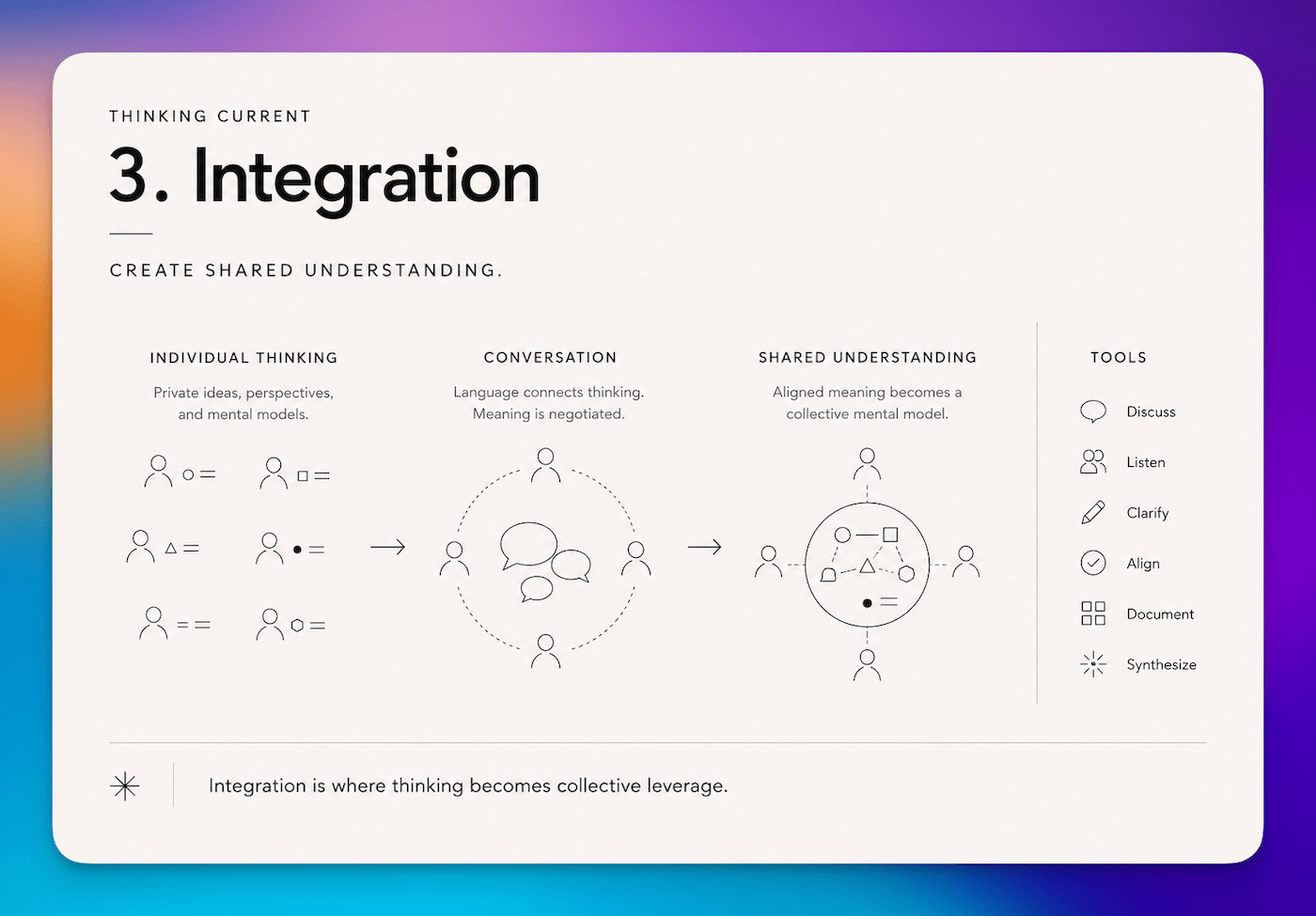
Integration is the Alignment Space. The idea moves into the public forum so you can extend your idea into a shared understanding.
Have conversations.
Talk to your team, think out loud, and share your works in progress. If you wait until the final version to share, you miss the opportunity to discuss earlier versions and capture feedback within each stage.
Ideas are delicate, so know how volatile the idea is before you bring it to the surface.
As the idea matures, so does the rigidity of thought. The idea becomes more fortified, making it harder to change the further along you get in one direction. Talking about the idea earlier incorporates more context and perspectives. In a high-trust environment, it makes the idea better and the end result more holistic in its shape.
Each of the notecards I write on during the week comes from conversations. I notice things and talk about them. Through the discussion, the idea takes shape and forms in the collective consciousness of the team working on it. It matures and grows.
Integration is the collective cognition.
I write these newsletters for me. I hope they help others think about their work, but the primary goal is so I can formalize my thinking and integrate new ideas into my craft. If I was doing this to build stronger shared mental models for everyone reading this, I’d share the thinking earlier. I’d have conversations, collect perspectives, and iteratively build a shared mental model to increase the impact.
Language is the raw material of integration.
It’s how humans have built common knowledge about the world. When I say the word “dog”, we’re all thinking about the same thing (in English). Sure, we’re probably not thinking about the same breed of dog, but it’s still a domesticated animal on four legs.
That’s a form of integration. We share the same collective cognitive structure to know what “dog” means at such a large scale. It takes a lot of processing power to get to that level of integrated thinking.
How does AI fit in? Well, talking to AI is another type of conversation (when you engage in a back-and-forth), but it’s different because of the downsides of LLMs. They’re sycophantic, meaning they will almost always agree with you. In a society already dealing with algorithms placating biases, this is especially dangerous.
Integrated thinking needs rigorous debate, diverse perspectives, and the willingness to change one’s mind.
I talk to people about ideas and collaborate with ChatGPT. My wife can only handle my diatribes so much, so I need space to build on the knowledge I’ve constructed.
I have custom projects with exported PDFs of every newsletter I’ve written. I also have shared chats where I expose my thinking and prompt ChatGPT to help with framing and naming. It would be a waste of the technology to not engage with something preloaded with everything I’ve written. That immediate knowledge, used effectively, is another layer of collaboration to drive integration.
Human and AI collaborators, weighted to formation over generation, increase the strength of your thinking. Use them wisely.
The Practice
The practice of the Thinking Current is focused on formative grounding and generative expansion. Spend more time in formation before generation. Leverage different spaces and modes to maintain coherence all the way through.
There are five steps:
- Capture to preserve the signal. Manually notice yourself before you let AI over-optimize the process. Everyone using background agents and “tell me what’s important” outsourcing will chip away at their critical thinking. Stay the course. Use notecards, notebooks, voice notes, quick sketches, and highlights as raw artifacts of thought.
- Shape to build the mental model. Slow down intentionally to build the structure, find the relationships, and determine causality. This is the most important part of the thinking process. This is formative shaping through coherence.
- Expand to increase the possibility space. Bring in AI systems, research tools, conversations, collaborators, and external perspectives. Moving from formation to generation here is a useful step because the foundation of understanding is already made. AI expands formed thinking. This is the generative exploration.
- Pressure-test to expose the idea to reality. Use demos, conversations, feedback, discussion, teaching, early written drafts, and collaborative review. Look for tension. Find the strengths through the resistance. This is formative integration. Like Scenario A, without attention and participation, no integration can occur.
- Distill to integrate the clearest version. Take the formed idea and compress it into principles, frameworks, essays, visuals, and systems. Let AI help refine and simplify. Translate the understanding that already exists into a clear mental model to ground generation in formation. This creates coherent outputs instead of synthetic outputs. The distillation becomes new signals to inform more thinking.
The Throughline
I had focus time this week to go deeper into our product strategy. I spent a lot of time shaping all the signals I captured, expanding the possible solutions, pressure-testing through brainstorming discussions with collaborators (human and AI), and distilling the final strategy down into a less-than-200-word visual narrative.
Don’t skip the distillation step. I used to write long strategy documents. The more words, the more thinking, right? Not necessarily. And you make it exceptionally difficult for others to understand—too much complexity. So now I go wide and divergent with the initial formation, but then iterate until the idea is as simple as possible.
I shared this simplification with the team to capture feedback. There were early thoughts, but you need to let it percolate. They need time with it. I’ll continue to socialize the idea, refine it further, and then build the shared mental model for the team. That’s leveraged knowledge.
Start by collecting the signals into analog and digital notebooks.
Then work on forming the ideas into maps. Keep working with analog and digital.
And then integrate the idea through conversations with human and AI collaborators.
Favor formation over generation. Don’t shortcut the thinking required to create better outputs you actually understand. Be the person who stands out in the age of AI-produced homogenized “slop.” Keep thinking alive.
Connected Ideas
The Thinking Current lives in the Clarity Current of the Claritorium and Quality Refinement of Equilio. And it connects to other ideas:
- Thought Lab for systemizing internal cognition.
- Knowledge Alchemy for transforming understanding.
- Surface Control for managing cognitive complexity.
- Collaborative Clarity for shared cognition.
- Human Calibration for organizational coherence.
Enjoying this issue? Sign up to get weekly insights in your inbox: