Strategic Field
I don’t like product roadmaps.
I specifically don’t like the traditional roadmap detailing all the features you’re going to build set against a specific time horizon.
But they’re everywhere. Every company I’ve worked in expects a roadmap.
If only we have this artifact listing out everything we’re working on now, next, or later, then our product will succeed!
Right?
Not at all. The traditional roadmap is a shallow representation of the work. It attempts to collapse strategic direction and focused execution into a single artifact anyone can understand. Yet it always devolves into a list of features.
But why are you building these features?
Why not do this other thing instead?
Why do we need this now?
The roadmap misses all the thinking and underlying tensions driving the work. The reasoning, the intention, the context is hidden behind outputs.
Trying to create a long-term roadmap is an illusion of control. There’s no way to predict market conditions on that time horizon.
It’s all guesswork until you do the work.
That’s why knowing the reason matters.
The Parenting Example
My kids are on summer break. With young kids, this is a high-anxiety moment for parents because the previous school schedule is replaced with what I can only describe (at least for my kids) as “aimless chaos.” They have to learn how to function as independent entities without a rigid schedule.
We have three simple family core values:
- Self Reliance: Take care of yourself.
- Mutual Care: Take care of each other.
- Right Action: Do the right thing.
We hope instilling these values results in the creation of kind, independent thinkers.
These are what I call “themes” in product work. They define the strategic direction without boxing you into a rigid plan. Intention before execution.
From your themes, you build “streams” of focus that arise from tensions. You sense the tension when using repeated language. In parenting, repetition is embedded in everyday communication. You repeat the same phrases over and over.
“Pick up your toys or you can’t have toys.”
“Find something to do quietly.”
“Sleep is important.”
And it just so happens those are the exact tensions bubbling up for us.
- Grateful Ownership: Cleaning up toys.
- Independent Play: Playing responsibly.
- Shared Spaces: Getting to sleep.
Each stream maps to one of the themes.
- Independent Play → Self Reliance
- Shared Spaces → Mutual Care
- Grateful Ownership → Right Action
From the streams, you generate targeted, strategic interventions as responses—a project, a task, an experiment. I say “response” here because product work often focuses too much on projects. Tasks are important; experiments are important. You need to respond with the appropriate work to create behavioral change.
For each response, define a intention and respond to generate a positive outcome.
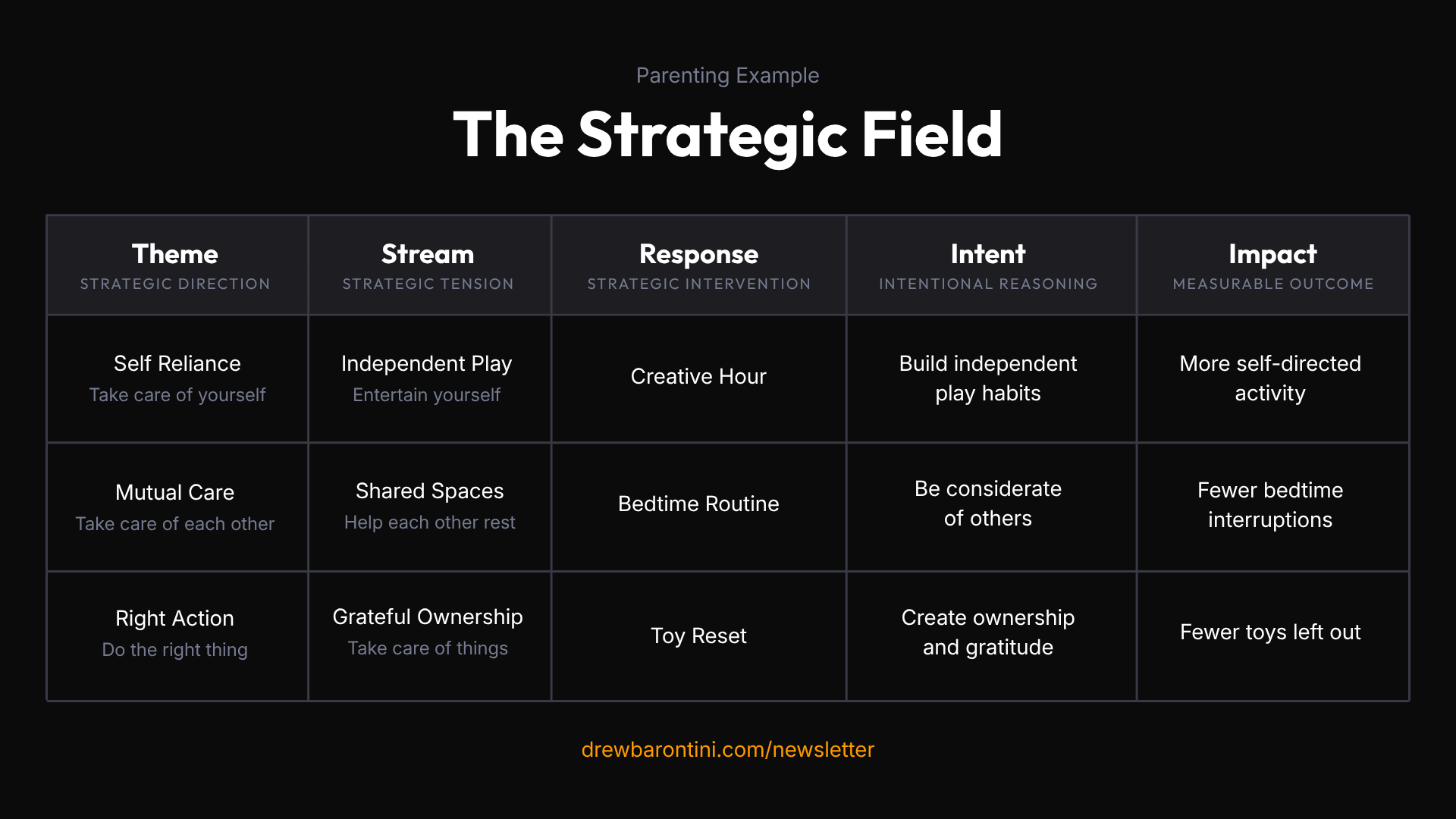
The Strategic Field
I call this the Strategic Field:
- Theme = Strategic Direction
- Stream = Strategic Tension
- Response = Strategic Intervention
- Intent = Intentional Reasoning
- Impact = Measurable Outcomes
Theme → Stream → Response → Intent → Impact
The work flows bi-directionally downstream and upstream. It’s continuous. Instead of listing what you’re doing, you explain why you’re doing it and what you expect to happen. You surround the work with context.
I don’t know what our responses are for the kids yet.
The tensions emerged, and now we design the targeted interventions to learn. We don’t begin with an extensive project. We start small to learn, iterate, and grow. We adopt an experimental mindset to keep improving.
The theme creates direction.
The stream identifies tension.
The response generates feedback.
The intent maintains focus.
The impact defines success.
This structure is visualized to represent the product strategy and focused execution in a single artifact. There are no dates or unnecessary details. It creates a natural filtration system to prioritize work. And anyone can immediately understand what you’re working on and why you’re working on it. When something doesn’t line up, it’s obvious. When a stream doesn’t feel necessary anymore, another one will naturally fill its place. But only when you’re open to the emerging signals. Pay attention to data, to conversations, to tensions. Notice what shows up and let it feed back into the system.
Streams don’t come from planning. They emerge from continuous, messy discovery.
You need to:
- Talk about the work. Have messy, divergent conversations. Think out loud.
- Notice the patterns. Look across quantitative, qualitative, and intuitive data.
- Name the signal. Wrap the tension in language to make it easy to understand.
Talk about the work
You need to find the language. Doing so shapes the tension into a core idea to hold the tension in place. Then you use it to define the work—the response, intent, and impact.
Conversation is the fuel of discovery.
As more conversations take place in isolated AI chats, the discovery of emerging signals is masked by homogenized responses. The streams are already there. You need the language to find and use them. And you can’t do that if you constrain and isolate your thinking with only the AI chat and associated context of its training data.
Talk to your team, think out loud, and challenge your own assumptions.
Notice the patterns
Patterns are signals of repetition. Language is syntax to codify patterns. When you think out loud and explore divergent perspectives, mantras emerge.
After we released a new feature, we noticed patterns of customers struggling with usage. In discussions, we noticed we’re getting in the way of people unlocking value.
Don’t get in the way of value.
I kept repeating this phrase in our brainstorming sessions and strategic conversations.
Moving from the conversation to the connection is when you look at the data:
- The quantitative data like how many users are hitting their usage limits.
- The qualitative data like support tickets and interviews with high-use customers.
- The intuitive data like the felt tension of missing the opportunity for growth.
Find the patterns, notice the signal, and move forward with directed action.
Name the signal
Language names the signal. You compress the idea into a syntactic representation to make it easily transmissible. This is a meme. And no, not the “internet meme” with cats; the meme as Richard Dawkins defined it as an idea that spreads.
Compress the idea without losing coherence.
Not enough compression and you end up with noise.
Too much compression and you end up with distortion.
I like pairing a shorthand name (1-3 words) with a short mantra (3-5 words):
Self-Serve Growth: Make it easy to unlock value
Find the signal and compress it into an idea that’s easy to understand.
The Practice
Here’s a compressed version of this idea to put it into real practice for your team:
- Define the themes. Look at long-term themes emerging in the product.
- Identify the streams. Talk out loud, notice the patterns, and name the signal.
- Focus on the response. Design strategic interventions to experiment.
- Frame the intention. Make the reasoning sound to focus the work.
- Measure the impact. Know what success looks like and what you need to learn.
The Artifact
Here’s a simple example of the artifact using the parenting example. It shows one response per stream, which is a simplified representation. In a real product example, there’s typically 3-5 responses running against a single stream. And there can be more themes than streams, which is part of the strategy because you can’t focus on every surface area of the product at the same time. Your attention should shift around to follow the emerging energies and signals.
The Throughline
Real product work requires intuition. No playbook or framework or LLM will save you from the judgement necessary to make the right calls about what to do and not to do.
An LLM matches patterns. It’s logical, calculating, efficient. Humans match patterns, too. Yet we’re also intuitive, emotional, and intentional. These are features, not bugs. We feel things; we have perceptions; we build rich mental models in our brains.
A roadmap of features doesn’t tell the story of product work.
Themes set direction; streams surface tension. The best products live in the tension to develop focused interventions to test, to measure, to learn. They’re built on clear intentions designed to generate a specific outcome.
Enjoying this issue? Sign up to get weekly insights in your inbox: