Thinking Management
I worked on a new pricing strategy. I started writing. I wrote down everything about the current state of pricing: the artifacts already created, the progress of work, the questions, the tensions, and the outcomes I wanted to achieve with the new strategy.
And then I had an idea.
I created a new project in Claude.
I uploaded all the files to the project and started a conversation to kick things off. I opened a chat and used it to create a project description and custom instructions. I then had multiple, separate conversations to construct different representations of the current state of thinking.
I had Claude create spreadsheets and HTML visualizations. I could almost immediately reflect the thinking as a visual. I’m a visual person, so seeing it that way spawned new ideas. And then I could add those artifacts to the project’s files. Each new conversation could then build on the existing data—the current state of thinking.
I also had multiple live conversations with people on my team. After each one, I went back to the project and opened a new thread, refining the thinking with each pass.
I was managing the thinking.
The visual representations were an interface for the current state of thinking.
This is Thinking Management.
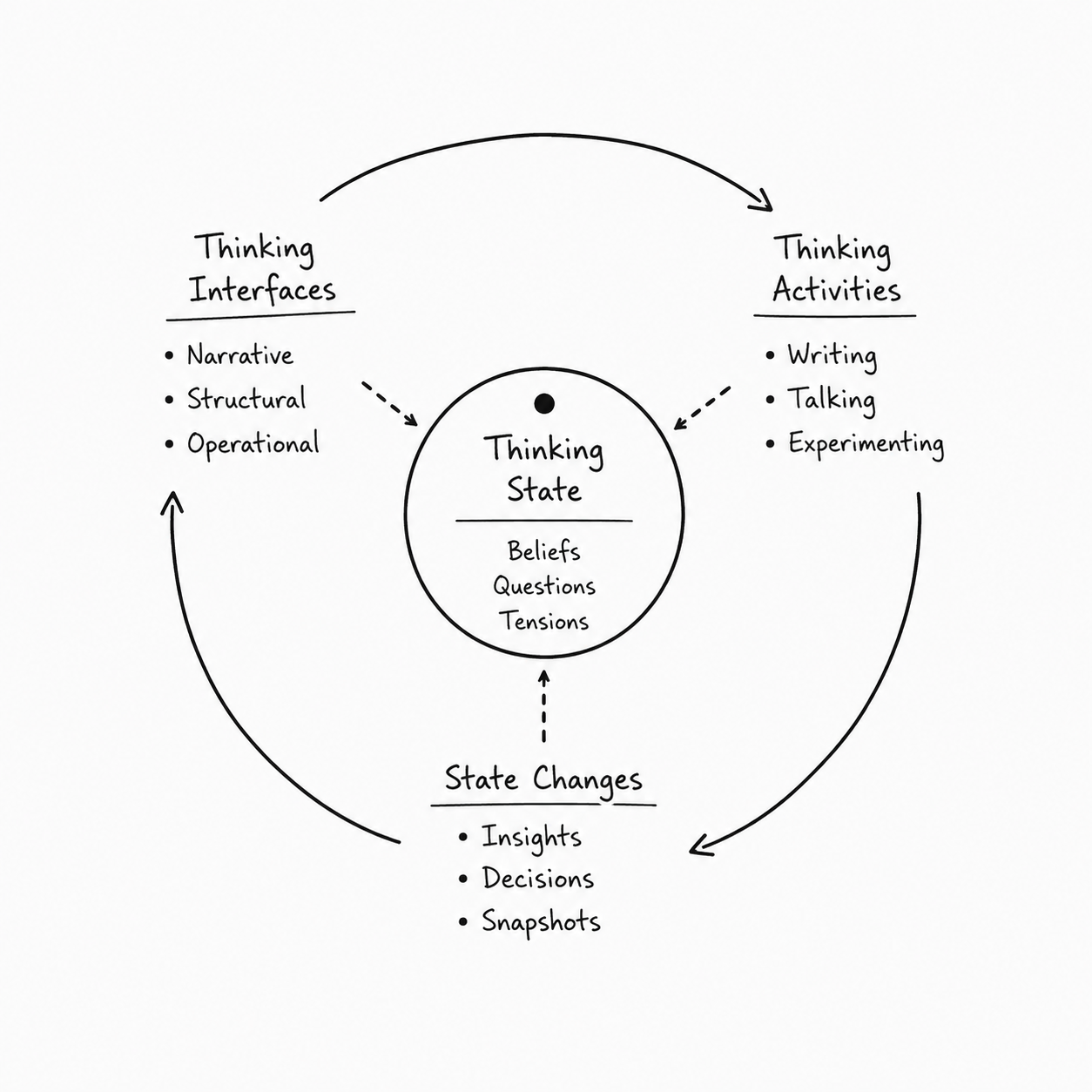
It’s made up of:
- Thinking State for the idea itself.
- Thinking Interfaces for the representations.
- Thinking Activities for the mechanisms of evolution.
Thinking State
The current state of thinking is the core from which everything else orbits. It affects and is affected by everything around it.
And it’s fluid.
Thinking should always evolve as new information becomes available.
Thinking State is the core understanding of the thinking at a single point in time. It’s made up of the Current State and State Changes.
It’s the stored state.
Current State
The Current State is what exists now. This is how you’d answer the question “where are we?” when asked about the current thinking.
- Beliefs are what we believe.
- Questions are what we don’t know.
- Tensions are what doesn’t reconcile.
Given the question:
What’s the current thinking state?
You answer with what you currently think is true (beliefs), what you’re still trying to figure out (questions), and what tradeoffs or conflicts are driving the work (tensions).
Those answers represent the current thinking.
State Changes
The State Changes are how the current thinking evolves. They convert a static representation into a dynamic state.
- Insights change beliefs.
- Decisions resolve questions.
- Snapshots preserve state.
In software, state changes occur when someone clicks a button, types in a text input, or initiates some interaction with the product.
When that happens, the state changes:
- The button click opens a modal.
- Typing in the input shows the text.
- Scrolling down the page reveals new text.
State Changes in thinking—insights, decisions, snapshots—alter the Current State of thinking to move knowledge forward so you can represent the thinking in new ways.
Change Examples
Now let’s look at some examples of State Changes using the pricing strategy example.
Belief → Insight
Customers don’t clearly understand the differences between our pricing plans.
Customers understand the differences, but they aren’t confident they’ll receive enough value before paying.
Question → Decision
Which pricing dimension matters most to customers: seats, usage, or features?
Run customer interviews and analyze upgrade patterns to evaluate pricing sensitivity across those dimensions.
Tension → Snapshot
Simplicity improves adoption, but flexibility improves monetization.
The snapshot captures the beliefs, questions, and tensions at a point in time:
- Belief: Customers don’t understand plan differences.
- Question: Should pricing be based on seats, usage, or features?
- Tension: Simplicity vs flexibility.
This is like Artifact Mining (Issue #35) for your thinking. Intentionally distill explicit changes in thinking as a snapshot.
Thinking Interfaces
The interface of a product helps someone interact with state. Each screen represents a state, an action occurs, and then the state changes to create a new interface. This is how we use software products to do something.
Thinking Interfaces are how you represent the Thinking State. You create artifacts to frame the idea into a coherent mental model.
The artifact is the interface of the idea.
I love writing because I can express an idea in words. The words are like affordances (buttons, copy) in a product, forming the interface of an idea. But I also like to take that idea and form new mental models with charts, graphics, and other visuals.
Each interface is an expression of the idea.
Thinking State answers “what is the current understanding?”
Thinking Interfaces answer “how should that understanding be represented?”
There are three types of Thinking Interfaces:
- Narrative Interfaces explain reasoning.
- Structural Interfaces shows relationships.
- Operational Interfaces create experiments.
Narrative Interfaces
Narrative Interfaces explain the state. You weave together a coherent explanation for the idea through documents, memos, briefs, essays, strategic narratives.
Answer “what does the state mean?”
Structural Interfaces
Structural Interfaces organize the state. You show relationships and formalize the idea through frameworks, models, maps, diagrams, taxonomies.
Answer “how is the state organized?”
Operational Interfaces
Operational Interfaces apply the state. You represent the state through action with roadmaps, plans, decisions, experiments, workflows.
Answer “what do we do with the state?”
Thinking Activities
Thinking Interfaces represent the state. They change, they morph, they evolve. And they do this through specific Thinking Activities.
- Writing and using language to shape thinking.
- Talking and blending other perspectives with your own.
- Experimenting and putting ideas into action with active testing.
Writing
When I start working on an idea, I write. Putting words down forces you to frame, shape, and position your thinking. You engage in rigorous debate, articulate thoughts, and attempt to create understanding out of language.
Writing is thinking.
As a Thinking Activity, writing helps you generate insights, answer questions, and develop a timeline of iterative developments in thinking.
The Thought Lab (Issue #25) is a great way to organize your written work.
Talking
Writing alone doesn’t let an idea flourish. Talk it out. You can do this with an LLM, but you can’t shortcut your critical thinking. Asking it to disagree with you just means it will disagree with you. It holds a position; it doesn’t have an opinion. So be mindful.
Talking is collaborating.
Talk with other humans and people you work with. Intentionally engage different perspectives to sharpen your thinking.
I had several conversations with other people and then integrated the thinking back into new chats in the Claude project. The new thoughts were State Changes to add insights, make decisions, and save more versions of the idea.
Collaborative Clarity (Issue #27) builds shared mental models of understanding.
Experimenting
Writing and talking move an idea forward, but action produces information. If you want to make a clear decision, you need more context—quality context.
Experimenting is learning.
Have an assumption? Test it. Have a question? Test it.
Experimenting is how you test an idea. The pricing strategy makes a lot of assumptions about how customers would receive the ideas. To test that, you can experiment with live conversations to capture qualitative feedback.
The Fieldbook (Issue #28) paired with an Experimental Mindset (Issue #15) operationalizes testing your ideas.
The Practice
The practice of Thinking Management looks like this.
- Create a project. Create a dedicated project for the idea, which becomes the persistent container for the Thinking State.
- Gather existing interfaces. Upload everything that currently represents the idea as project files to form the foundation that represents the current thinking.
- Establish the state. Use the “Thinking State Initialization Prompt” below to determine the current state of thinking you need to evolve.
- Create new interfaces. Once you understand where the state is, then you can represent it in different interfaces—narrative, structural, operational.
- Evolve the state. As work progresses, update the project. Add new threads, upload files, build new interfaces. Continue to evolve the thinking.
Thinking State Initialization Prompt
Analyze all project materials and construct the current Thinking State.
For each category, identify the strongest signals available.
Beliefs
What do we currently believe to be true?
List the key assumptions, conclusions, and working theories.
Questions
What do we not yet understand?
List the most important unanswered questions.
Tensions
What conflicts, tradeoffs, or contradictions are driving the work?
List the major tensions currently present.
Insights
What meaningful changes in understanding have occurred?
Identify notable shifts in thinking.
Decisions
What decisions have already been made?
List decisions that currently constrain or guide future work.
Snapshot
Create a short snapshot of the current Thinking State that can be reviewed quickly.
The Throughline
The future belongs to people who preserve their ability to think slowly inside systems designed for speed.
— From Thinking Current (Issue #89)
Thinking Management is how you work inside a system with thinking as the fuel. It’s like a “hybrid intelligence” where the AI project becomes an organization layer for intentional thinking. Writing, talking, experimenting become activities to improve thinking. You have one place to visit when you need to find out the latest state, refine it, and keep a trail of thinking. Each new thread refines the last, but stays centralized and documented. So then you can express the visual whenever you need an interface for the current thinking.
Traditional AI is prompt to output.
Thinking Management is state to interface.
In software, state is as an interface that changes state through interactions. In thinking, current thinking is expressed as a thinking interface. Thinking activities then affect the state and create new interfaces to form a coherent mental model.
Thinking Management is a system of thinking as a flywheel of continuous learning.
Enjoying this issue? Sign up to get weekly insights in your inbox: